Dover disruption becomes a national political test
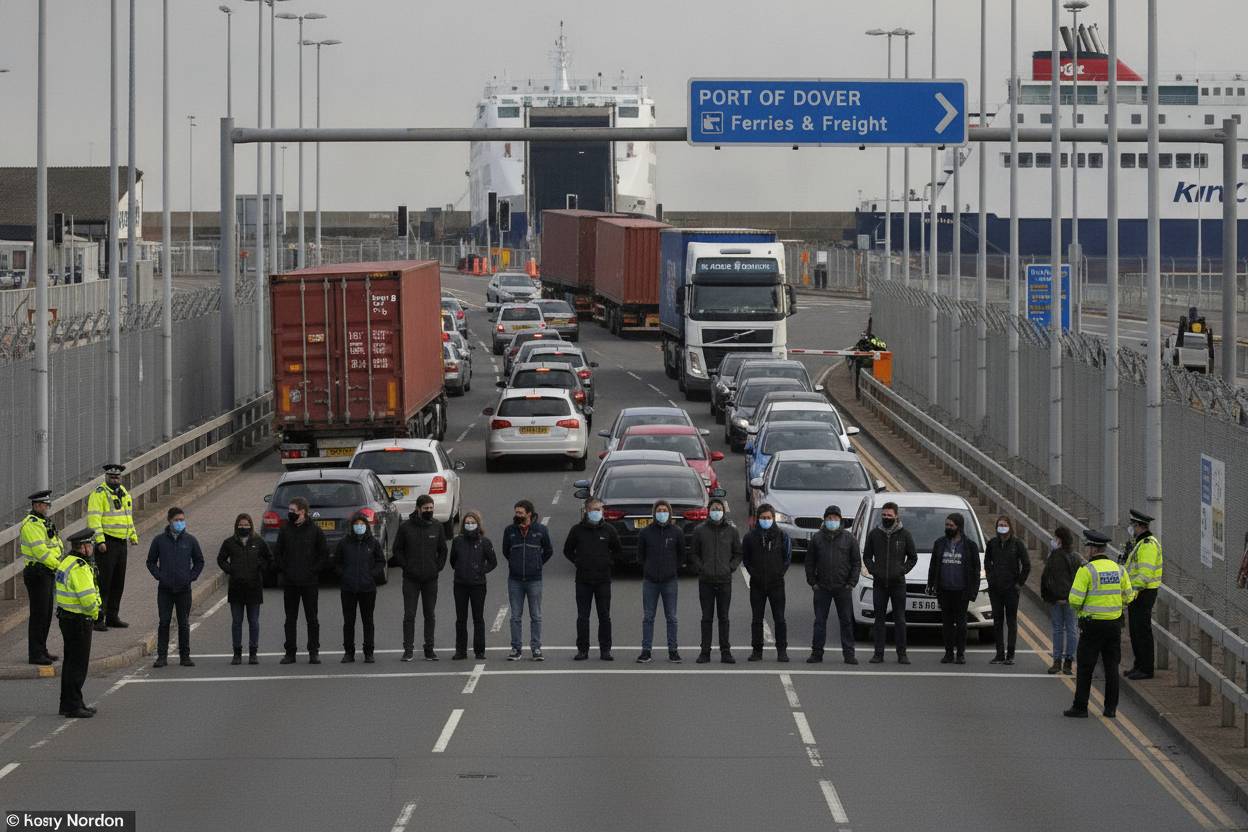
Britain’s long-running argument over irregular migration returned to one of its most symbolically charged locations this weekend, after hundreds of masked anti-immigration protesters blocked roads into the Port of Dover, briefly halting traffic at the country’s busiest ferry gateway to France.
The demonstration, which unfolded on Saturday, 5 September 2026, stopped vehicles entering and leaving the port and caused significant disruption to passengers, hauliers and local traffic. The Port of Dover later said operations had returned to normal, but not before the incident underlined how migration has again become entangled with public order, border politics and the authority of the state.
The protesters’ message was explicit. Chants and placards focused on small-boat Channel crossings, illegal migration and the claim that successive governments have failed to restore control of the border. Social-media posts amplified by Stephen Yaxley-Lennon, better known as Tommy Robinson, suggested the blockade was not simply a spontaneous local grievance but part of a wider anti-immigration mobilisation. Even where formal organisational responsibility remained blurred, the political meaning of the action was unmistakable: Dover was chosen because it sits at the intersection of sovereignty, trade and migration.
For ministers, that matters. The Labour government has sought to present itself as tougher and more competent than its Conservative predecessors on border management, while pairing enforcement with legal reform and closer cooperation with France. Official policy since the passage of the Border Security, Asylum and Immigration Act 2025 has been to strengthen disruption of smuggling networks and tighten the wider asylum and immigration system. A further Immigration and Asylum Bill, introduced in Parliament on 30 June 2026, is intended to reshape asylum rules, modern slavery provisions and appeals processes.
Yet the politics remain combustible because the numbers, though improved in some respects, have not made the issue disappear. Official migration data show long-term net migration to the United Kingdom fell to 171,000 in the year ending December 2025, nearly half the level of the previous year. But separate debate around unauthorised Channel arrivals continues to exert an outsized influence on public opinion. Parliamentary and academic briefings published in recent weeks indicate that while small-boat arrivals have declined during 2026, the route remains active and politically salient. In that environment, highly theatrical protest can have an impact out of all proportion to its duration.
Dover also carries a particular constitutional sensitivity. This is not merely a road network or a protest site; it is critical national infrastructure, handling strategically important passenger and freight traffic between the United Kingdom and continental Europe. Blocking access to the port therefore turns an immigration protest into a wider test of whether the state can protect commerce and mobility while upholding lawful protest rights. That explains why ministers and police moved quickly to distinguish peaceful demonstration from direct disruption.
The authorities’ response reflected that balancing act. Kent Police said officers were engaging with protesters as the incident unfolded, while government figures condemned the action as having gone beyond legitimate protest. The language was significant. British governments have tightened protest law in recent years partly on the argument that essential infrastructure must be protected from obstruction. Critics will now ask whether those standards are being applied consistently, regardless of the ideology of those involved.
Across the Channel, the episode will also be watched closely in Paris. Anglo-French cooperation remains central to attempts to reduce dangerous crossings in the Strait of Dover, with both governments expanding joint operations, personnel and surveillance measures during 2026. A blockade at Dover may therefore harden pressure on both capitals: in London to show visible control, and in Paris to demonstrate that joint enforcement is producing results quickly enough to retain political legitimacy.
What happened in Dover was not simply a transport disruption. It was a reminder that migration policy in Britain is judged not only by legislation or statistics, but by whether the public believes the border is orderly, fair and governable. In that sense, a few hours of blocked roads have reopened a much larger question about political trust.