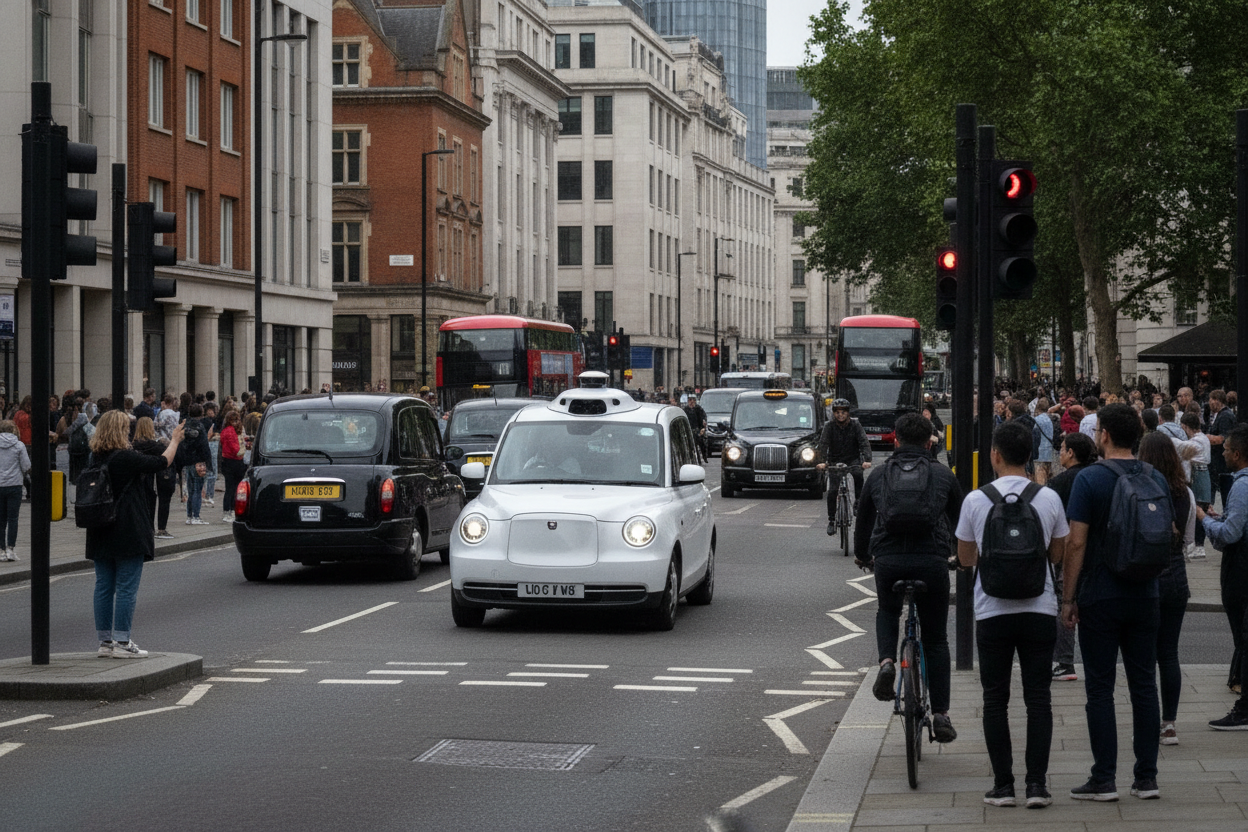
London’s robotaxi market takes a decisive first step
London’s first self-driving taxis for hire have begun operating on city streets, marking a symbolic and commercial milestone for one of the world’s most closely watched urban transport markets. The launch moves autonomous ride-hailing in the UK capital out of the realm of pilot projects and into the early stages of a consumer-facing business, with implications that reach well beyond transport.
The timing matters. In 2026, the UK government has been pushing ahead with a framework to allow small-scale self-driving passenger services, and London has become a focal point for both policy ambition and public caution. City Hall has acknowledged that several autonomous passenger vehicle trials are under way, while national regulators have set out pilot schemes designed to let operators run taxi- and bus-style services under strict safety conditions. That regulatory groundwork has created the opening for commercial deployment, even if the market is still tightly controlled and limited in scale.
For operators, the attraction is obvious: London offers dense demand, high transport costs and a global profile that can turn a successful launch into a reference case for other cities. A functioning robotaxi service in the capital could help prove that autonomous vehicles are not merely a laboratory technology but a viable transport product. It also offers the possibility of lower labour costs, more predictable fleet utilisation and a service that can be scaled through software rather than traditional driver recruitment.
But the business case is not straightforward. Autonomous ride-hailing depends on public trust, regulatory permission and operational reliability. London is one of the most complex driving environments in Europe, with heavy traffic, mixed road users, constrained streets and a public transport network that remains the city’s backbone. Any incident involving a self-driving taxi would quickly become a test not only for the operator but for the wider sector’s credibility. For investors, that makes the upside large but the execution risk equally high.
The competitive landscape is also shifting. Traditional ride-hailing platforms are likely to view autonomous services both as a threat and a potential partnership opportunity. If robotaxis can operate safely and at lower marginal cost, they could pressure conventional private-hire pricing over time. Yet established platforms already possess brand recognition, app infrastructure and customer data, which may allow them to integrate autonomous fleets faster than new entrants can build demand from scratch. In that sense, the first phase of competition may be less about who owns the vehicle and more about who controls the customer relationship.
From a regulatory standpoint, London’s launch is likely to intensify debate over safety, liability and labour. The government has sought to position the UK as a leader in autonomous mobility, arguing that the sector could support jobs and economic growth. Critics, however, are likely to focus on the implications for licensed taxi and private-hire drivers, especially in a city where driving work is part of a broader ecosystem of urban employment. Labour groups and some local politicians may argue that the benefits are being tilted towards technology firms and fleet operators before the social costs are properly understood.
Consumer reaction will probably be mixed. Some passengers will be drawn by novelty, convenience and the promise of tech-enabled service improvements. Others will remain sceptical about riding in a car without a human driver, particularly in the early months when the service may still rely on safety protocols, mapped routes and operational restrictions. That tension between curiosity and caution is likely to shape adoption more than pricing alone.
For the UK as a business story, the significance lies in the transition from policy debate to market testing. London is now serving as a real-world proving ground for a technology that could reshape urban mobility, vehicle economics and transport regulation. Whether the outcome is a rapid commercial breakthrough or a slower, more cautious rollout, the first self-driving taxis for hire have already changed the conversation: autonomous transport is no longer a hypothetical future for the capital, but an active business model being tested in public.